Manawatina+
Tūtakangahau Williams26 May 2026A Discussion on Māori Masculinity
Masculinity for tāne Māori has a long and complex history, impacted by colonisation. Tutakangahau Williams and Hirini Kaa share some thoughts on where we might head as tāne Māori to renew our ideas around masculinity.
First up Tutakangahau shares his whakaaro around being tāne Māori:
Despite the dominant and negative narratives about who we are as Māori men, our tīpuna were loving and affectionate fathers, open in their emotions and vulnerabilities. Balance was paramount to living a healthy life. Over time, colonial models of masculinity have disrupted that balance and influenced how many of us express ourselves as Māori men today.
I have been brought up by both strong women and strong men whose life lessons—and even the unspoken moments—are etched deeply in my mind.
More than the skills or lessons themselves, it was the way they carried themselves that shaped me. The tikanga and values they lived by—te noho whakaiti, te manaaki i te tangata—remain embedded in my whakaaro.
As a father, husband, son and koro, I hold tightly to the lessons of the tāne who raised me or were prominent in my upbringing.
I believe it is important for a tāne Māori to feel useful—to their iwi, hapū and whānau.
What is my contribution?
Am I going to be a great ancestor?
Sport is one space where I’ve reflected deeply on masculinity and mana tāne. Rugby, boxing and MMA as physical sports are often associated with harmful, hypermasculine behaviour—and in many cases, that is true. I don’t dispute that.
But two things can be true at the same time.
Sport, particularly whutupōro, gave me pride in representing my iwi, I built lifelong relationships, and it provided an outlet for weekly stresses and pressures. It offered a space of controlled challenge—where competition was intense, but temporary. When the game ended, so did the conflict.
Now, as a father, I see my boys navigating their own challenges—ki te taha hinengaro me te taha wairua. Their world is different from mine, just as mine was different from my father’s.
Yet some things remain.
They yearn for physical expression, movement, and challenge. This is not something to suppress—it is something to guide.
I want them to be strong enough to protect their whānau if needed, but also gentle enough to show love to others and themselves. We as Māori men are many things- protectors, advocates, counsellors and providers and we navigate through these roles all the time.
There is balance between Tūmatauenga and Rongomātāne. When that balance is right—when it is tau—that is one way I believe that we can flourish as Māori men.
Hirini Kaa shares his thoughts:
I was brought up Ngāti Porou, where we had wāhine speaking on the pae and our marae are nearly all named after wāhine. My own marae Hinepare was named after one of three sisters who presided as Rangatira over the Northern end of the Waiapu valley. I grew up surrounded and shaped by women of great mana and tapu.
The Empire brought models of masculinity that were destructive. As new Victorian ideas of domesticity and the place of women were taking root in England, they were also being enforced here. Legal structures which disinherited our wāhine Māori also elevated tāne Māori in often unhelpful ways. Ideas of a woman’s place being in the home and the man being the provider became a model enforced through the colonial education system.
So tāne inherited unhelpful models that didn’t fit. And when combined with the violence we learned in schools and society it made for some terrible, oppressive, domestic environments which spiralled into intergenerational trauma. When it came to our pain, men learned to be angry and silent, and passed that down.
There were of course always exceptions. I experienced loving, gentle, men who shared their joy of life and of living. But I also had lots of angry, violent whanaunga that found solace in drugs and alcohol.
The renaissance has renewed our celebration of being as we were created – Ngāti Porou and miscellaneous others. We can find joy and pride in our mātauranga and its expression in tikanga. We don’t have to hide our culture or live in such fear.
However, we still have some work to do around being tāne. Our celebration of our toa spirit can be expressed as a form of hyper-masculinity that worries me at times. After all the truest expression of toa is in violence, and violence is a problem for us in all its forms.
We also look for a pure expression of masculinity in our haka, in our pūrākau, and in other forms. This can be essentialised, where there’s little room for diverse sexualities and those who don’t fit as well into these cultural notions of gender.
Let’s find joy in being as we were created, while ensuring that we bring forward the life-giving dimensions of that creation.
FURTHER READING
Gordon, L. (2023). Reclaiming Māori masculinities: Identity, wellbeing, and resistance. Te Whāriki Journal, 8(1), 2–6.
Rua, M., Hodgetts, D., & Stolte, O. (2017). Māori men: An indigenous psychological perspective on the interconnected self. Māori & Psychology Research Unit, University of Waikato. https://researchcommons.waikato.ac.nz/entities/publication/55d6b374-1245-496d-a95d-311f019d3af6
Brendan Hokowhitu, Tackling Māori Masculinity: A Colonial Genealogy of Savagery and Sport, The Contemporary Pacific, Vol.16(2), pp.259-284, 2004
Jessica Hutchings and Clive Aspin (Eds), Sexuality and the Stories of Indigenous People, Huia, (2007)
Dana L. Robert, ‘The ‘Christian Home’ as a Cornerstone of Anglo-American Missionary Thought and Practice’, in Dana L. Robert ed., Converting Colonialism: Visions and Realities in Mission History, 1706-1914, Grand Rapids, 2008
Dr Benita Simati-Kumar13 May 2026A Pōwhiri of Values
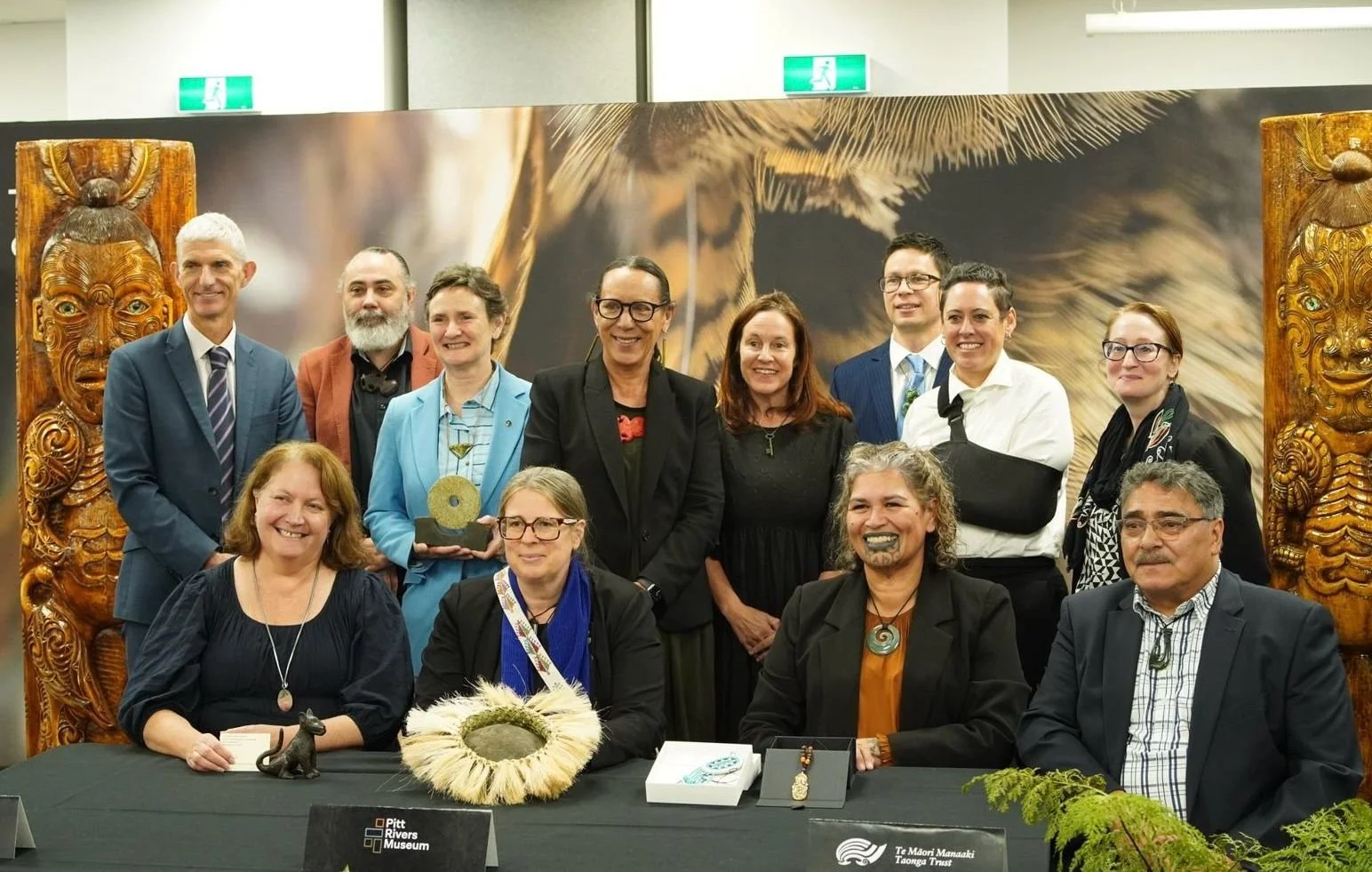
A pōwhiri was held recently to celebrate the relationship between Pitt Rivers Museum, Te Māori Manaaki Taonga Trust and Te Wānanga o Aotearoa. It was unexpectedly powerful, bringing together diverse emotions, histories and futures.
Dr Benita Simati-Kumar and Dr Hirini Kaa reflect on their experiences in light of Ngā Uara.
Dr Benita Simati-Kumar reflects on our uara of Kotahitanga and Te Whakapono.
Kotahitanga
In my experience, haka pōwhiri is where kotahitanga is not just spoken about, but fully embodied. Race, position, religion, hierarchy, and ego are checked at the door. In that moment, Te Wānanga o Aotearoa kaimahi—from the Chief Executive to the groundskeeper—become one body, one voice, one intent.
The pōwhiri setting—simple to an onlooker—is complex and deliberate. Operational staff execute each detail with precision. As you enter, no instructions are needed; bodies simply know where they belong within the vā. A space that holds raranga classes in the morning and noho for the evening becomes a humble yet powerful site of ceremony, marking a significant milestone for the Wānanga and Oxford.
The room falls into silence as the first notes of Haani’s karanga travel through the walls, activating the space before they enter. The atmosphere shifts. Our collective voices rise and ignite the room, calling our manuhiri forward and signalling that we are present and united. Irrespective of individual haka ability, experience, or confidence, we stand arm to arm with those more practiced than us. We follow their lead. Our hands move in unison, timed to the same beat. Voices that begin tentatively grow louder, stronger, carried by those beside us. You feel the mauri swell and recognise, deeply, that this is kotahitanga in its purest form.
In this space, yesterday’s worries lose their weight. What once felt heavy is now carried by the collective and becomes lighter by the second. The cool air of the morning fog fades as warmth settles deep in the puku. Language once perceived as foreign becomes clear; Te reo Māori activating the space as a language of aroha, connection, and intentionality. An Indigenous language that acknowledges the vast vā between us, speaking to your ancestors and mine, without ego, without hierarchy. Here, difference is not erased—it coexists—held together by our shared commitment to the kaupapa.
This is uniquely and unapologetically Te Wānanga o Aotearoa, where space, practice, and people align to uphold Ngā Uara.
Te Whakapono
When I speak of the potential of vā, I refer to a reinvigoration of our collective consciousness and connectedness. It is the intrinsic human pursuit to reach beyond what is known, to seek new horizons that nourish growth and sustain our ways of knowing. The Pitt Rivers Museum MoU signing pōwhiri captured this essence with clarity and intent.
The relationship formed in that moment was not transactional; it was relational. It was grounded in trust and the belief that shared values would be upheld and that collective responsibility would guide the relationship forward. Te Whakapono was not declared; it was enacted. It was visible in how people moved through space, how they listened, how they stood together, and how tikanga was honoured without compromise.
From a spatial and vā-based lens, te whakapono lives in how space holds relationship. The pōwhiri created a vā where histories, emotions, and futures could sit together without tension needing resolution. It allowed both institutions to meet not as equal in form, but as equal in intent, each acknowledging the other’s depth, responsibility, and whakapapa.
Everyone present carried a role, not only within the ceremony but in the future of this kaupapa. Te Whakapono places obligation on all of us, to act with integrity, to remain in relationship, and to tend the vā with care long after the karakia ends. Maintaining the potential of vā requires active trust, continuous presence, and confidence that our connections—carefully established in ceremony—will be honoured through action. In this way, whakapono becomes both the foundation and the future of the relationship between Pitt Rivers Museum, Te Māori Manaaki Taonga Trust and Te Wānanga o Aotearoa.
Dr Hirini Kaa reflects on our uara of Ngā Ture and Te Aroha
Ngā Ture
Several years ago I visited the Pitt Rivers Museum in Oxford. I walked in the front door and saw a large space filled with cabinets of taonga from across the world. To be honest it looked like a bit of a mess with the only constant being the Empire taking what it wanted as it expanded its power. When I looked closer I saw tūpāpaku from various lands. I walked straight back out.
Since then Pitt Rivers, under the influence of Indigenous scholars from across the world, has come to understand itself and its impact on the world. It understands now that it was part of the Empire’s work to categorise and dominate the world, weaponising “research” against the Indigenous peoples it sought to suppress and exploit.
One of those Indigenous scholars was our very own Te Kura Toroa - Evie. Her relationship with Director Professor Laura Van Broekhoven not only enhanced this journey of self-awareness and decolonisation but also began a process of Indigenisation and embracing and embedding Indigenous values and mātauranga (worldviews) into the life of the museum. The tūpāpaku, for example, have been removed and repatriation has begun.
Thus the pōwhiri embraced the spirit of Ngā Ture – upholding what is right.
Te Aroha
This spirit of Te Ture - Te Ture Wairua me Te Ture Tangata manifested in the pōwhiri in the spirit of Te Aroha.
After such a sad history, there should be anger. Matua Hemi offered a powerful whaikōrero, which to me offered a recognition and a challenge to this past. Instead of anger, there was an acceptance of wrong done in the past, and a welcome which offered reconciliation and peace – te hohou o te rongo.
This reconciliation came in the form of a person. Mākereti Papakura (Tūhourangi) was the first female Indigenous scholar at the University of Oxford. Her amazing legacy was recently recognised by the University, including the posthumous awarding of her MPhil in Anthropology.
Through the work of Evie, when you enter into the Museum nowadays instead of tūpāpaku you see Mākereti. And this was acknowledged at the pōwhiri, including the presence of the Vice Chancellor of Oxford.
This is the work of forgiveness and reconciliation. This is what aroha looks like.