
Finding the True Meaning of ‘Being a Teacher’
What does it mean to be a teacher? How do you articulate your philosophy of teaching? Katherine Harvey poses these pātai to her tauira regularly and in this article she makes an attempt to answer it herself.
Nestled into the back half of the first year of He Korowai Ākonga (Bachelor of Education) kōnae ako, there is an aromatawai that asks our tauira to identify and explain their philosophy of teaching. And every year it is met with groans, "but I just want to be a teacher!"
I mean, the tauira have a point. Trying to articulate a philosophy of teaching in their first year of study is a daunting task. So, as their kaiako and in the spirit of ako wānanga, I thought I'd tackle the aromatawai too. My students tell me that they like how I bring clarity and make complex things simple, but I wonder at the complexity of 'being a teacher' and I wonder if anyone can really articulate it. My head swims with anecdotes from my 20 plus years in various classrooms (in and out of school contexts), quotes and challenges from experience, research, and all the administration tasks of the academic year.
Claudia Rozas Gōmez in Understanding enduring ideas in education used the verb phrase "thinking intentionally" as a way of saying that thinking philosophically is an action. I resonate with this and her assertion that becoming a teacher involves more than learning to teach; it is more than methods and skills. In my simple articulation - teaching is both a practical art and an intentional philosophy. To be a 'teacher' is to enable, empower, inspire, and encourage another into their full potential.
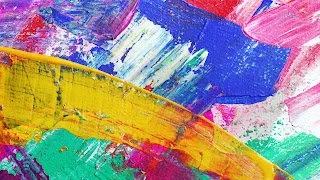
So, I chose this image, it's just a stock image from a search on pixaby.com, but it resonates with my understanding of what it is to be a teacher - the bold yellow swipe across the mix of green, pink, blue and white. The evidence of brush strokes, uneven layers of paint and no clearly defined lines or shapes, speaks to me that being a teacher is both a recognised skill and an evolving, intuitive craft.
As the painter has shown, the mix of colour and composition of lines are important; they are the art. An experienced teacher knows this too; the mix of curriculum and pedagogy is the composition of knowledge and activities to match the needs of the learner. The skill comes in believing that what you are doing is right - so the lesson plans and programmes crafted look like art; rather than a mess.
I believe there is an intuitive knowing that is needed within teaching. Some of us in the profession call this "teacher with-it-ness" students might recognise it as "the teacher has eyes at the back of their head." It's a holistic knowing that allows authentic relationship and engagement; teaching that prioritises relationship over content delivery and allows space and time for curiosity, inquiry and mess. It is inherently selfless and demands the celebration of others successes.
My philosophy of teaching includes operating in praxis that nurtures the whole person—their mana, their curiosity, and their potential. In practice, this means moving away from strict adherence to any one educational theory or isolated, unidirectional lecture, toward reciprocal spaces of learning. A teacher enacts ako when they sit alongside students as co-inquirers—incorporating localised pūrākau (narratives) to explore complex social concepts, opening space for tauira to bring their own lived experiences into assessments, or actively sharing their own learning journey to normalise vulnerability and professional growth.
I am at my core a curious, truth-seeker. And I have come to understand that "being a teacher" is more than just knowing curriculum content and learning progressions. It's more than delivery strategies and interactive activities too. Since working as Kaiako at Te Wānanga o Aotearoa, I have come to value the integration of mātauranga Māori into my philosophy of teaching, especially when grounded in concept-rich values like whanaungatanga (relational connection) and manaakitanga (unconditional care). Within my practice, mātauranga Māori provides another lens of understanding and further clarifies my purpose as 'teacher.'
‘Teaching as art’ is vitally important for anyone in education to own, because (and I will use Claudia's words here), "teachers play a central role in determining the meanings they give to education in their classrooms." (p. 11) In short - it is important to be intentionally thinking about our practice. Where do my ideas come from? What or who influences my decisions?
The value of philosophical thinking for a teacher is that it helps to articulate the all-important WHY. Why did I decide to train to be a teacher? Why do I stay committed to the profession? Why do I remain creative and passionate?
Teachers in every sector of education within New Zealand are bound to adhere to the Teachers' Council Codes and Standards. These Codes and Standards are our ethical guideposts, our responsibility to uphold, and our obligation to emulate. But the fact is - teaching in NZ is wildly eclectic in its makeup. Four leading ideologies underpin our historical and current education practice: progressive, conservative, liberal democratic, and socio-cultural. These ideologies are regularly in tension with each other.
In a landscape often caught between competing educational philosophies, and political ideologies, individual teachers must seek steady wisdom that grounds their 'why' and elevates the mere job of teaching into a transformative, resilient and deliberate choice to win.
I think Rip Wheeler (Yellowstone) said it well when he eyeballs a stroppy, terrified Carter and tells him that there are only two paths in life: "One is you're winning or learning. And the other is you’re losing all the way to the f**ng grave.” (Sheridan, 2021)
I believe that.
Recent research reinforces the potential of teaching and learning to be transformative. Professor Melinda Webber in her work on the Mana Model (2024) emphasises student success and thriving are deeply tied to educational environments that explicitly foster a sense of cultural identity, belonging, and innate authority (mana).
I will finish with a question from Claudia's text: "What meaning will I give to education?"
I'm still working it out.
Katherine Harvey (Ngāti Pākehā) is a Kaiako in He Korowai Akonga
References:
Rozas Gómez, C. (2017). Introduction: Becoming teachers and the value of philosophical thinking. In C. Mutch & J. Tatebe (Eds.), Understanding enduring ideas in education: A response to those who "just want to be a teacher" (pp. 1–15). NZCER Press.
Sheridan, T. (Writer & Director). (2021, November 14). Under a blanket of red (Season 4, Episode 4) [TV series episode]. In T. Sheridan et al. (Executive Producers), Yellowstone. Paramount Network.
Teaching Council of Aotearoa New Zealand. (2026). Introducing the 2026 standards for the teaching profession. Teaching Council of Aotearoa New Zealand.
Webber, M. (2024). Teaching the mana model—A Māori framework for reconceptualising student success and thriving. Set: Research Information for Teachers, 2024(1), 2–11. https://doi.org/10.18296/set.1545